THE PLAYING FIELD
Laser Chess is played on a 9 × 9 board. The Red and Green players start on opposite sides of the board, with the Red player making the first move.
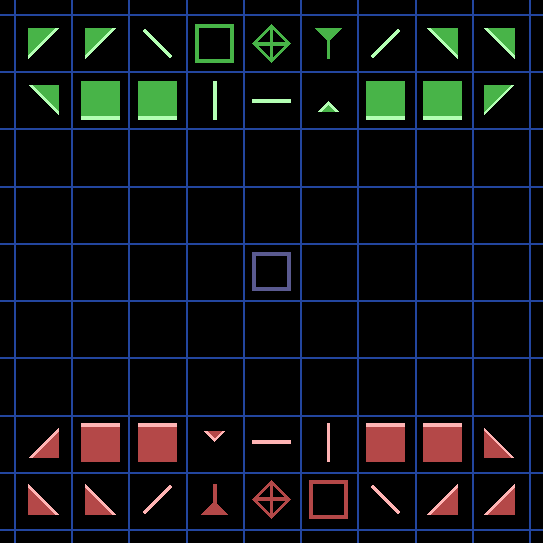
GAME PLAY AND TURNS
Players take turns and may make up to two actions per turn. Each of the following counts as one action:
- Moving a piece one square up, down, left, or right. Diagonal travel is possible if the path is clear — it just costs both of the turn's actions.
- Firing the Laser. The laser may only be fired once per turn.
- Rotating a rotatable piece. Rotations are in 90° steps. Rotating a piece all the way back to an equivalent orientation refunds the action.
You can use your actions to capture other pieces by stomping over them with the King or a Block, to teleport a piece by stepping into it with the Hypercube, to rotate the Laser or a mirror to set up an offensive or defensive line, or to fire the Laser and try to vaporize an enemy piece. Each piece carries its own once-per-turn cap on its stomp, teleport, or fire action.
The game ends when a player's King is destroyed.
THE PIECES

KING
The most important piece. If your King is destroyed, you lose. The King has no reflective surfaces, so a beam from any direction is fatal. It can capture an opposing piece by moving onto its square, but only once per turn.

LASER
Your primary offensive piece. Rotate it to aim, then fire. The Laser cannot capture and has no reflective surfaces, so protect it well. In Laser Chess your own beam will not destroy your own Laser.

DEFLECTOR (DIAGONAL MIRROR)
The diagonal mirror is immune to the Laser and reflects beams 90°. Two consecutive 90° rotations of a Deflector return it to an equivalent orientation, so the second rotation refunds its action.

STRAIGHT MIRROR
Immune to the Laser. Reflects an axis-matched beam 180° back along its path, and lets perpendicular beams pass through. As with the Deflector, two 90° rotations are equivalent — the second one refunds.

TRIANGULAR MIRROR
One reflective face and one exposed back. A head-on hit on the reflective face bounces the beam 180°. A hit on the back destroys it.

BLOCK
An offence-and-defence piece. Like the King, a Block can capture an opposing piece by moving onto it (once per turn). It has mirror protection on one side, so head-on shots from that side are reflected back, but shots to its exposed sides destroy it.

BEAM SPLITTER
The only piece that can create beams. A beam striking the splitter at its vertex (the point joining the two mirrors) splits into two perpendicular beams. A beam returning along either of those split paths re-enters a side face and emerges back through the vertex. The exposed back face destroys the splitter when struck.

HYPERCUBE
The Hypercube is unique. It is transparent to the Laser — beams pass through unchanged. Like any other piece it can be captured by an opposing stomper. When you step onto another piece with the Hypercube, that piece is teleported to a random square, in a random orientation. The Hypercube can teleport only once per turn.

HYPER HOLE
A board feature, not a piece — it belongs to neither player. A laser beam that enters a Hyper Hole is absorbed. A piece that steps into one is teleported, just as if it had stepped onto a Hypercube, to a random location and orientation.
GAME STRATEGY
If you are new to Laser Chess, the best teacher is a player who already knows the game. Failing that, start two side-by-side games and play both colours yourself for a turn or two — getting a feel for what each piece does is much faster hands-on than from text. Find someone else who is also new and learn together. The original Laser Chess is over thirty years old and still played because the rules are simple and the geometry is rich.